
Skip to content
Kruthac Software logo
Back to Home

Threat Intelligence

Actionable intelligence to stay ahead of emerging threats. Real-time threat feeds, automated detection and blocking, incident enrichment, and comprehensive reporting to protect your organization at scale.

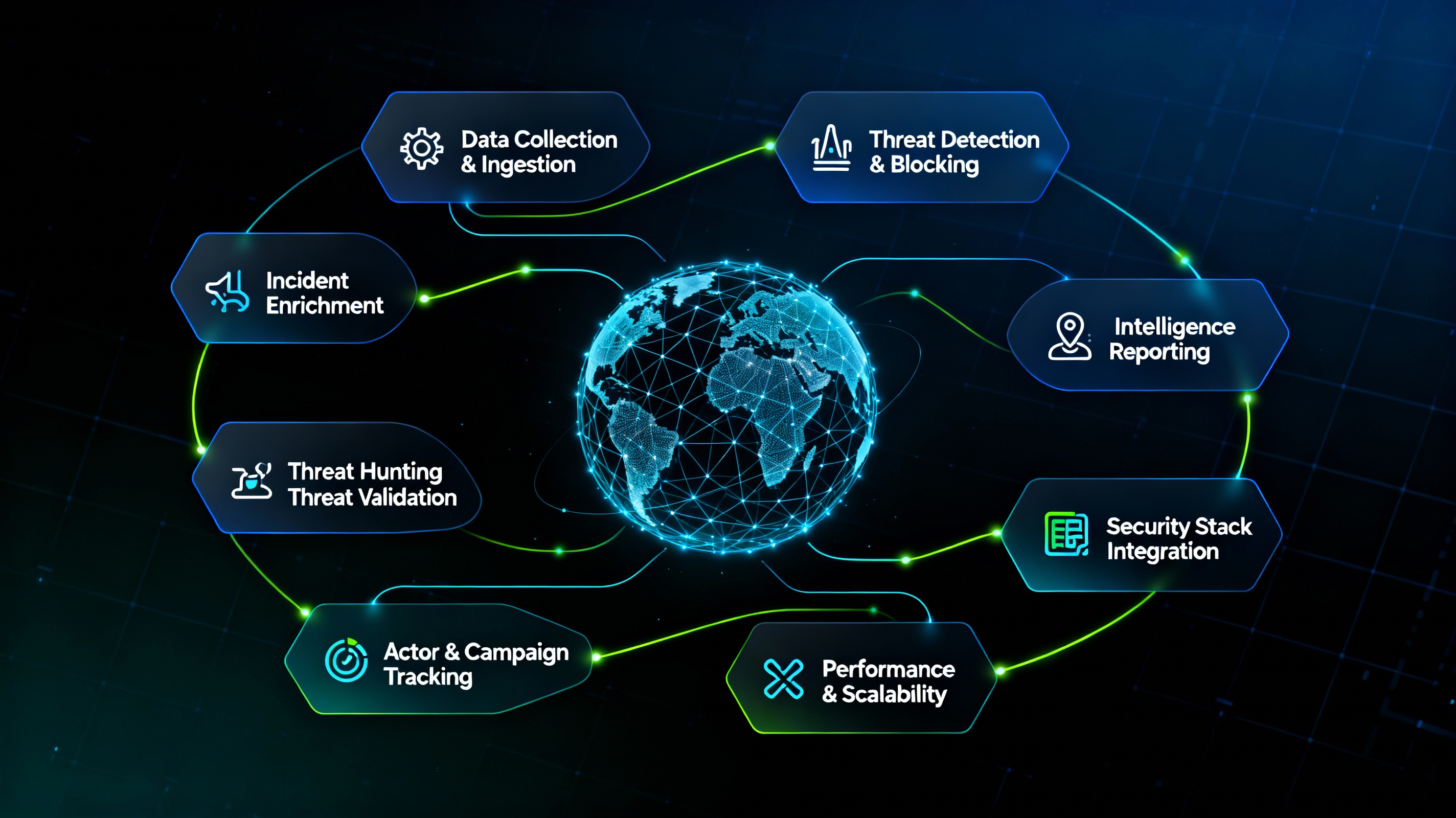
Threat Intelligence - Real-time threat detection and response

Data Collection and Ingestion

  • Verify automated ingestion from multiple threat feeds (commercial, open-source, ISAC/ISAO, dark web, OSINT) with correct normalization and deduplication.
  • Test parsing and enrichment of indicators of compromise (IoCs): IPs, domains, file hashes, URLs, and CVEs, ensuring metadata (threat actor, TTP, severity) is accurately attached.

Enterprise: Validate high-volume feed handling (millions of IoCs) with performance and scalability tests.

SMB: Confirm lightweight, curated feed integration without overwhelming small SOC teams or budgets.

Threat Detection and Blocking

  • Test proactive blocking by pushing IoCs to SIEM, firewall, EDR, and email gateways, and confirm real-time alerting on matches.
  • Simulate known malicious domains, IPs, and hashes in controlled environments and verify that security tools block or alert as expected.

Enterprise: Validate orchestration across multi-cloud, on-prem, and hybrid environments with centralized threat correlation.

SMB: Test simplified, automated blocking rules that require minimal tuning or analyst intervention.

Incident Enrichment and Context

  • Confirm that alerts are enriched with threat intelligence context (threat actor profiles, campaigns, TTPs, geolocation, reputation scores) to prioritize response.
  • Test integration with ticketing systems (ServiceNow, Jira) so enriched alerts auto-populate incident tickets with actionable intelligence.

Enterprise: Validate deep forensic enrichment including MITRE ATT&CK mapping, kill-chain phase, and historical campaign linkage.

SMB: Ensure clear, plain-language summaries of threats with recommended actions, avoiding analyst jargon.

Threat Hunting and Proactive Search

  • Test threat-hunting workflows: analysts should be able to pivot from IoCs to related campaigns, malware families, and affected assets.
  • Validate retrospective searches (lookback) across historical logs to identify compromised systems that interacted with newly discovered IoCs.

Enterprise: Confirm integration with EDR/XDR for automated hunting queries based on ATT&CK techniques and adversary profiles.

SMB: Provide pre-built hunting queries and dashboards that non-expert analysts can execute with minimal training.

Intelligence Reporting and Distribution

  • Verify generation of customized threat reports for different audiences: executives (risk summaries), SOC (tactical IoCs), IT ops (patching priorities).
  • Test scheduled and on-demand report delivery via email, portal, or API with filters by geography, industry, or threat type.

Enterprise: Validate detailed threat modeling, actor profiling, and trend analysis reports with external threat landscape visibility.

SMB: Deliver concise, actionable weekly or monthly summaries highlighting top threats and one-click remediation steps.

Integration with Security Stack

  • Test bidirectional integration with SIEM, SOAR, firewall, proxy, EDR, and email security platforms to push IoCs and pull alerts.
  • Validate API and STIX/TAXII feed compatibility, and confirm that intelligence updates propagate across all tools in real time.

Enterprise: Check orchestration across multi-vendor stacks (Splunk, Palo Alto, CrowdStrike, etc.) with centralized policy management.

SMB: Ensure pre-configured connectors for popular SMB tools (Microsoft Defender, Cisco Meraki, Fortinet) with plug-and-play setup.

Threat Validation and Accuracy

  • Simulate false-positive scenarios (benign IPs flagged as malicious) and verify confidence scoring, whitelisting, and alert tuning workflows.
  • Test regular feed quality reviews: detection rate vs. false-positive rate, timeliness of IoC updates, and source reliability scoring.

Enterprise: Implement red/blue team exercises and MITRE ATT&CK-based validation to measure detection coverage and gaps.

SMB: Use sandbox replays of known attacks to validate that intelligence feeds detect real threats without analyst overhead.

Threat Actor and Campaign Tracking

  • Verify ability to track threat actors, campaigns, and malware families over time, linking new IoCs to historical activity.
  • Test attribution confidence levels and adversary TTPs mapping to MITRE ATT&CK for gap analysis and defense prioritization.

Enterprise: Provide detailed adversary dossiers with geopolitical context, motivation, and targeting patterns for strategic planning.

SMB: Highlight relevant threat actors targeting the SMB's industry/region with simple risk ratings and mitigation checklists.

Compliance and External Sharing

  • Test intelligence sharing with industry ISACs, government CERTs, and peer organizations via secure, anonymized feeds.
  • Validate compliance with data-handling regulations (GDPR, CCPA) for threat intelligence containing PII or customer data.

Enterprise: Confirm audit trails for intelligence usage, access logs, and sharing activity for SOC 2 and ISO 27001 audits.

SMB: Provide opt-in community threat-sharing with privacy protections and simple compliance attestations.

Performance and Scalability

  • Load-test ingestion of peak IoC volumes and confirm sub-second query response times in threat intelligence platforms.
  • Validate retention policies, archival, and purging of stale IoCs to maintain database performance without losing historical context.

Enterprise: Test multi-tenant and global deployment scenarios with distributed threat intelligence nodes.

SMB: Ensure cloud-based, elastic scaling with fixed or predictable pricing tiers and no infrastructure overhead.

Ready to Enhance Your Threat Intelligence?

Get started with comprehensive threat intelligence and protect your organization with actionable insights and real-time threat detection.

View All Services